The first break-in happened at the Patels' house, three doors down from mine. I didn't know they were the Patels at the time - I didn't know anyone on my street, really. We'd moved in eighteen months earlier, waved occasionally at the people next door, and otherwise kept to ourselves.
That's how modern neighborhoods work, I thought. Everyone's busy, everyone's private, everyone minds their own business.
Then the second break-in happened. Then the third. And suddenly, minding my own business felt less like privacy and more like vulnerability.
The police suggested we start a neighborhood watch. Great idea, except I couldn't name a single person who lived on my street. I didn't know who was home during the day, who traveled frequently, who might have security cameras, or who might have seen something suspicious.
So I did something that felt a little unusual: I used who is my neighbor searches to identify every household on my block. What started as a security measure became something much more significant - the foundation of a real community.
The Wake-Up Call
The break-ins followed a pattern. Someone was casing houses during the day, looking for signs of vacancy - no cars in driveways, no lights on, mail piling up. They'd hit the vulnerable homes quickly, take what they could carry, and disappear before anyone noticed.
The police were sympathetic but realistic. "We can patrol more often," the officer told me, "but the best defense is neighbors looking out for each other. You notice things we can't."
According to the Bureau of Justice Statistics, homes in neighborhoods with active community watch programs experience significantly fewer break-ins. But a community watch requires, well, a community. And we didn't have one.
I looked around at the houses on my street - fifteen single-family homes, maybe forty people total - and realized I couldn't name more than three of them. How were we supposed to watch out for each other when we didn't even know each other?
Mapping the Neighborhood
I started with the simplest tool available: property records. For each house on my street, I ran a quick search to find out who owned it and who lived there.
The results were eye-opening. Our street was more diverse than I'd realized:
- Four families with young children
- Three retired couples who were home most of the day
- Two rental properties with rotating tenants
- One house owned by an investor and vacant for renovation
- Several young professionals who worked long hours and traveled frequently
I could immediately see patterns relevant to security. The retired couples were our best daytime observers - home most hours, aware of comings and goings. The traveling professionals were the most vulnerable - their empty houses were obvious targets. And the vacant renovation property was a potential staging area for anyone casing the street. Understanding how to find property owners became the first step in building our community.
Making First Contact
Armed with names and addresses, I did something I should have done eighteen months earlier: I knocked on doors.
"Hi, I'm James from number 412. After the break-ins, I'm trying to get neighbors together to look out for each other. Do you have a few minutes to talk?"
The response was overwhelming. Almost everyone felt the same way I did - isolated, concerned, and eager to connect but unsure how to start. The break-ins had shattered our illusion of suburban safety, but they'd also created an opening for community building.
Within a week, I'd talked to representatives from every household on the block. We set up a group text chain for quick communication. We scheduled a neighborhood meeting at the park down the street. And we started actually learning about each other.
What We Learned About Each Other
The property records gave me names and addresses, but the conversations gave me something more valuable: context.
The Hendersons at the end of the block had a security camera system that covered the street entrance. They'd never shared footage because they didn't know anyone to share it with.
The retired couple at number 408 - the Garcias - walked their dog twice daily and knew the normal patterns of every car and delivery truck on the street. They'd noticed the suspicious vehicle before the break-ins but didn't know who to tell.
The young professional at 405 traveled for work every other week. She'd been nervous about leaving her house empty but had no one to check on it. Now she has three neighbors with spare keys.
Similar approaches work when you're researching neighbors before buying a home, but building community after you've already moved in is just as valuable.
Building the Watch
What started as a security response evolved into something more structured:
Communication Network
We created a private group chat for immediate alerts - suspicious activity, unexpected visitors, anything out of the ordinary. The retired neighbors became our daytime monitors; the night owls covered late hours.
Shared Resources
The Hendersons shared access to their security camera footage with the whole group. Three other houses added cameras at key angles, creating overlapping coverage of the street.
Vacation Coverage
When anyone travels now, they post dates in the group. Neighbors rotate responsibility for picking up packages, checking on the house, and making the property look occupied.
Regular Gatherings
We started monthly block gatherings - nothing fancy, just coffee on someone's porch or drinks in a backyard. The relationships we build in peacetime are the foundation of trust we need in emergencies.
The Property Searches That Made It Possible
None of this would have happened without that initial research. Understanding what property lookup reveals gave me the starting point I needed. Here's exactly what the "who is my neighbor" searches provided:
Owner names and resident names
Knowing who owned each property helped me distinguish between homeowners (likely long-term residents) and renters (potentially more transient). Both groups matter, but the approach to engagement differs.
Length of residence
The families who'd been here longest had historical knowledge of the neighborhood - patterns, problems, previous incidents. They became anchors for the community we were building.
Property type
Identifying the rental properties helped me understand why those houses had less engagement - tenants often feel less invested in neighborhoods they don't own. We made extra effort to include them.
Contact information
Some searches provided phone numbers or emails, making initial outreach easier. Even when that information wasn't available, knowing names made door-knocking less awkward.
The Results
In the two years since we started the neighborhood watch, our street has had zero break-ins. The surrounding area has continued to experience occasional property crimes, but our block has become an unattractive target.
Criminals look for easy opportunities. A street where neighbors know each other, watch each other's houses, and communicate quickly is not an easy opportunity. The visible signs of community - people waving, conversations on sidewalks, shared gatherings - signal that this is a place where strangers will be noticed.
But the security benefits, while real, have become secondary. What matters more is that I actually know my neighbors now. I know the Garcias are celebrating their 50th anniversary next month. I know the Patels' daughter just got into her first-choice college. I know the quiet guy at 418 plays guitar and has a dry sense of humor that only comes out after his second beer.
This is what neighborhood is supposed to feel like. And it took a crisis to remind us that it doesn't happen automatically - someone has to build it.
How to Start in Your Neighborhood
If you want to build community on your street, here's the process I'd recommend:
Start with research
Use property searches to identify who owns and occupies each house on your block. Having names makes everything easier. Techniques from reverse address lookup can help you get started.
Find your anchors
Identify the long-term residents, the retirees who are home during the day, the natural connectors. These people become the foundation of your network.
Create a catalyst
In our case, it was break-ins. Hopefully, you won't need a crisis. But you do need a reason to reach out - a block party, a shared concern about traffic, a community garden proposal. Something that gives you an excuse to knock on doors.
Make the first move
Someone has to break the ice. Knock on doors, introduce yourself, invite people to coffee. Most people want to connect - they just don't know how to start.
Create opportunities for interaction
Block parties, holiday gatherings, neighborhood cleanups - any excuse to bring people together reinforces the connections you're building.
Stay engaged
Community isn't built in a day. Keep showing up, keep reaching out, keep being the neighbor you wish you had.
The Street I Know Now
Two years have passed since the break-ins. My street looks the same from the outside, but everything has changed.
I know the Hendersons are traveling this month - I'm picking up their mail. The Garcias just had a baby - I brought over a casserole. Old Mr. Patterson hasn't been feeling well - we've organized a meal train. The rental at the end of the block has new tenants - I'll introduce myself this weekend.
These aren't grand gestures. They're the small, ordinary kindnesses that make neighborhoods work. They're only possible because I know my neighbors - not as strangers who happen to live nearby, but as people whose lives intersect with mine.
That text chain we started after the break-ins? It's still active. We use it for crime alerts, sure, but also for lost dogs, recommended contractors, extra zucchini from gardens, and invitations to backyard barbecues.
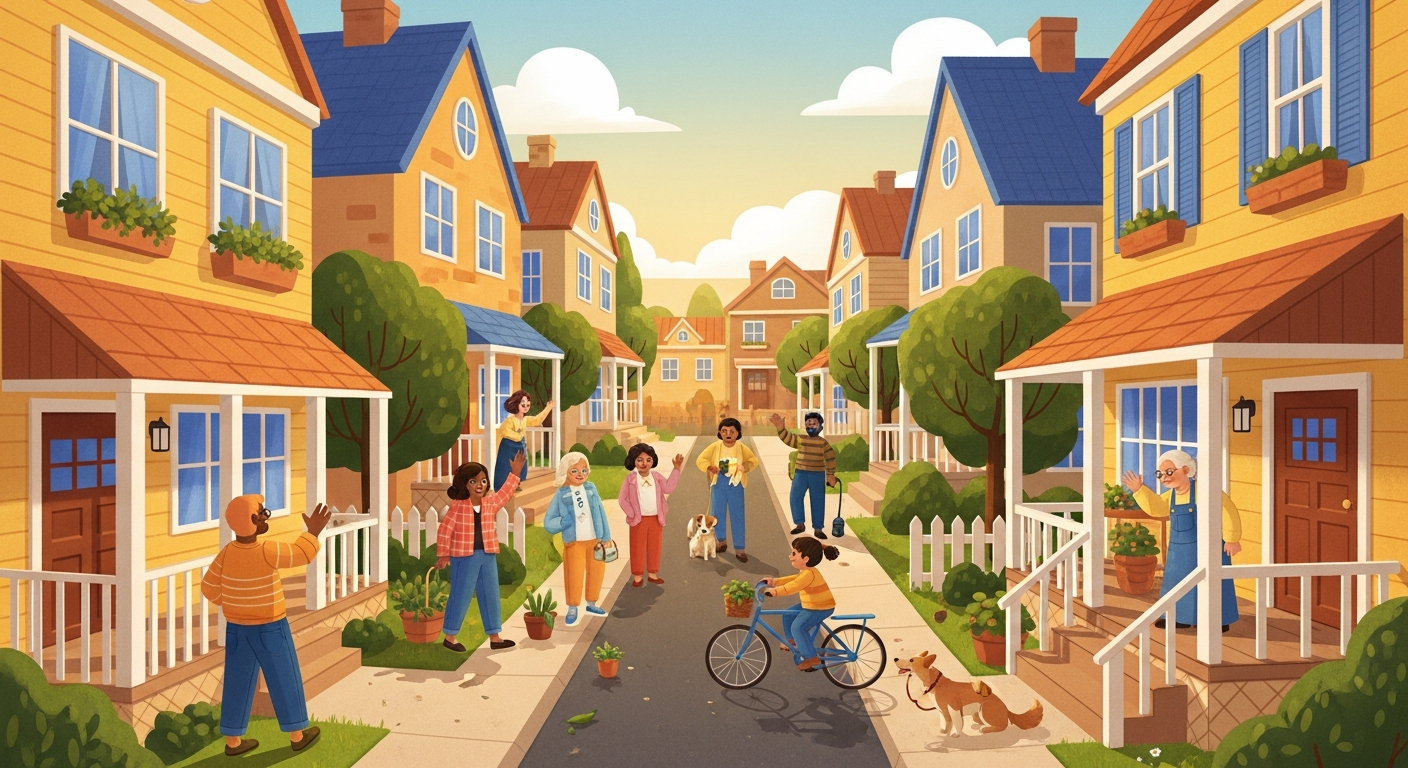
It turns out the answer to "who is my neighbor" isn't just a name in a database. It's the beginning of a community.