It started with a package on my doorstep.
The box was addressed to me, my name spelled correctly, my address accurate down to the apartment number. But the return address was just that - an address. No name. Just a street number in a town in New Mexico I'd never heard of.
Inside the box was a photo album. Old, leather-bound, filled with black-and-white photographs of people I didn't recognize. No note, no explanation, just dozens of faces staring back at me from what looked like the 1950s and 60s.
I should have been confused. Instead, I was intrigued. Who sent this? Why to me? And who were all these people in the photographs?
What followed was a week-long investigation using reverse lookup using address techniques that ultimately led me to discover a family secret that had been buried for sixty years.
Step 1: Starting with the Address
The return address was 847 Mesa Verde Road in a small town called Tierra Amarilla, New Mexico. Population: about 500 people. The kind of place where everyone knows everyone, and strangers stand out.
My first move was a basic property search. Who owned the property at that address?
The results came back quickly: the property was owned by someone named Dorothy Fuentes, age 83. She'd lived there since 1985, when she purchased the home from her parents' estate. Before that, the property had been in her family since 1962.
Dorothy Fuentes. I didn't recognize the name. But I did recognize something else: her maiden name, listed in the associated records, was Santos.
My name is Michael Santos.
Step 2: Mapping the Family Connection
Santos is a common name. The connection could have been coincidental. But something told me to dig deeper.
According to FamilySearch, one of the largest genealogical databases in the world, surname connections combined with geographic patterns often indicate family relationships worth investigating.
The property lookup showed Dorothy had associated relatives: a brother named Roberto Santos (deceased 2010), parents named Elena and Francisco Santos (both deceased), and a sister named - this is where my heart stopped - Maria Santos Parker.
Maria Santos Parker was my grandmother's name.
My grandmother, who had passed away when I was twelve. My grandmother, who had never mentioned a sister named Dorothy. My grandmother, who had told us her only sibling, a brother, had died young.
Either there was a remarkable coincidence happening, or my grandmother had lied about her family for my entire life.
Step 3: Cross-Referencing the Information
I wasn't ready to jump to conclusions. I needed to verify the connection before going further. The techniques I used are similar to those in our guide on reverse address lookup.
First, I looked up my grandmother's maiden name in our family records. Maria Santos, born 1942 in New Mexico. Her parents were listed as Elena and Francisco Santos - the same names that appeared as Dorothy's parents in the property lookup.
Second, I checked the birth years. Dorothy was born in 1942, the same year as my grandmother. If they were siblings, they would have to be twins - and nothing in our family history mentioned my grandmother being a twin.
Third, I dug into property records for my grandmother's childhood address, which I found in old family documents. She'd grown up on a ranch outside a small New Mexico town - not Tierra Amarilla, but close enough that the connection seemed plausible.
The pieces were forming a picture I didn't quite understand yet. But I was getting closer.
Step 4: Expanding the Search
I needed more information. I ran a deeper search on Dorothy Fuentes, looking for anything that might explain the connection to my grandmother.
The search revealed several interesting facts:
- Dorothy had never married and had no children
- She'd worked as a teacher in New Mexico public schools for forty years before retiring
- She was a member of several local historical societies
- Her contact information included a phone number that matched the area code for Tierra Amarilla
I also found a newspaper article from 2015, when Dorothy had donated family documents to a local historical society. The article mentioned that she was "preserving the legacy of the Santos family, early settlers in the Tierra Amarilla region."
This was my grandmother's family. There was no doubt now. The question was how Dorothy and Maria were connected - and why we'd never heard of her.
Step 5: Making Contact
I debated for three days about whether to call Dorothy. She was 83 years old. Whatever family secret had kept us apart for sixty years, was it my place to unearth it? What if she didn't want to be found?
But she'd sent me the photo album. She'd made the first move. She was reaching out.
I called on a Tuesday afternoon. A woman's voice answered, older but sharp, with a hint of a New Mexico accent.
"Is this Dorothy Fuentes?"
"Yes. Who's calling?"
"My name is Michael Santos. I think you might be related to my grandmother, Maria Santos Parker. I received a photo album in the mail, and I traced the return address to you."
There was a long pause. So long I thought the call had dropped.
Then, quietly: "I've been waiting for this call for forty years."
The Story Dorothy Told
Over the next two hours, Dorothy explained everything.
She and my grandmother weren't sisters - they were twins. Identical twins, born in 1942 to parents who struggled to care for two children during wartime hardship. When the girls were four years old, a decision was made: one would stay with the family, one would be given to relatives in another town who couldn't have children of their own.
Dorothy stayed. Maria - my grandmother - was sent away.
The families maintained contact for a few years, but eventually drifted apart. By the time the twins were teenagers, they'd lost touch entirely. Different last names, different lives, different worlds.
My grandmother had always known she was adopted by relatives, Dorothy explained, but the shame and pain of the separation led her to rewrite the story. She told people her only sibling had died. It was easier than explaining the truth.
Dorothy had searched for her sister for decades. She'd found traces - marriage records, address changes, newspaper mentions - but had never made contact. "I didn't know if she wanted to be found," Dorothy said. "Our parents' decision wasn't my fault, but I always felt guilty. Like I was the one they kept, and she was the one they gave away."
When Dorothy discovered that Maria had passed away, she was devastated. But she'd also found something else: my grandmother's grandchildren. Us. The family she'd never known.
The photo album was her way of reaching out. Images of the family Maria had been taken from. A visual history of the life Dorothy had lived while her twin sister grew up thinking she'd been abandoned.
What the Lookup Made Possible
Without reverse address lookup, I would have had no way to identify Dorothy. The package would have remained a mystery - beautiful photographs of strangers with no explanation.
But property records connected an address to a name. That name connected to associated family members. Those family members connected to my grandmother. And suddenly, a sixty-year family secret was revealed.
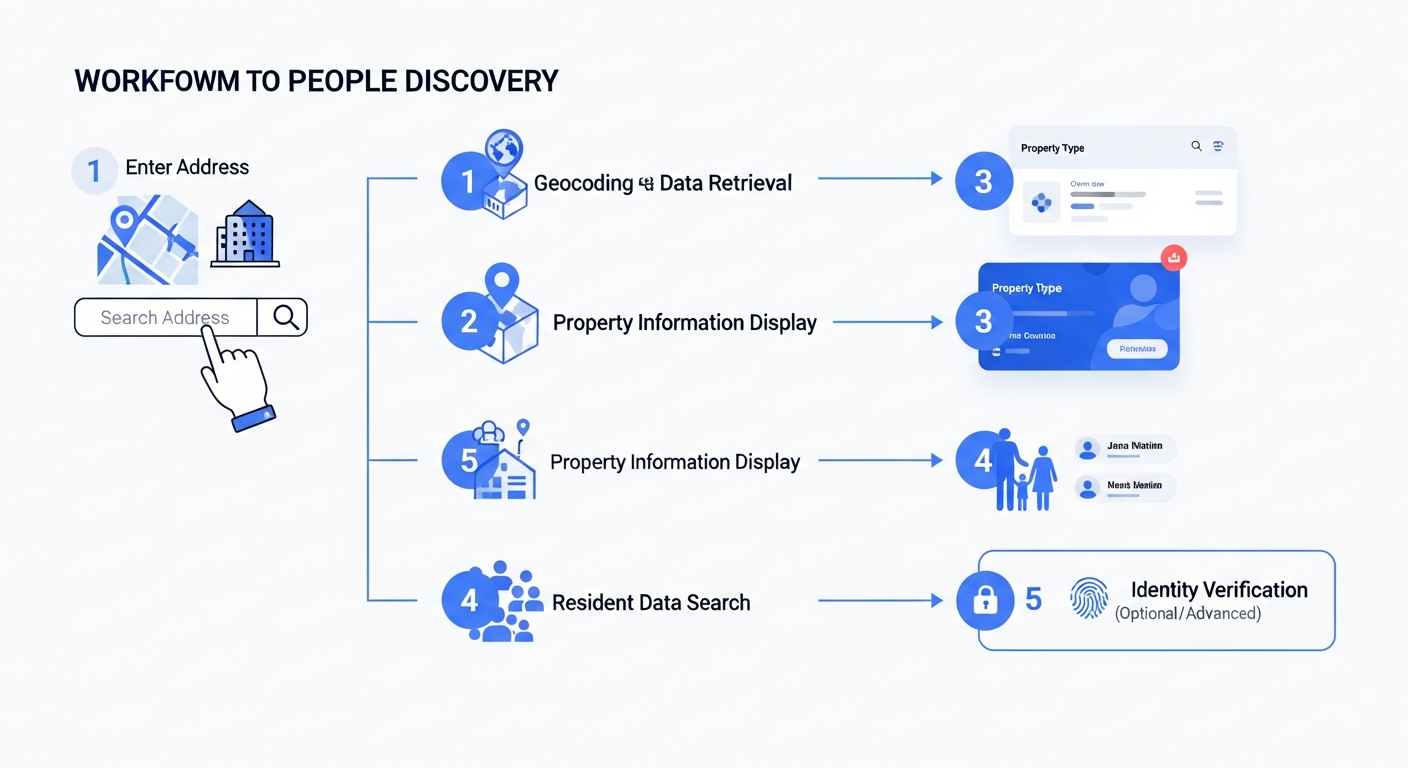
Here's the step-by-step process I used:
- Started with the address: Used reverse lookup to find the property owner
- Identified family connections: Cross-referenced names with my own family records
- Verified the information: Used additional property records and public documents to confirm the relationship
- Expanded the search: Gathered more context about the person before making contact
- Made respectful contact: Reached out with honesty and openness
The technology is simple. The implications can be profound.
Connecting with Family
I visited Dorothy in New Mexico three months after our first phone call. At 83, she was sharp as a tack, full of stories about the family I'd never known, the history my grandmother had hidden from us.
She showed me where my grandmother had been born - the same room where Dorothy had come into the world four minutes earlier. She took me to the cemetery where their parents were buried, graves my grandmother had never visited.
And she gave me more photographs. Hundreds of them. A lifetime of images that my grandmother should have been part of but wasn't.
It was bittersweet. My grandmother had died not knowing her twin sister was still alive, still thinking of her, still hoping for a reunion that never came. The decision made by desperate parents in 1946 had rippled through sixty years, keeping two sisters apart until it was too late.
But now Dorothy has us. Her twin sister's grandchildren, great-grandchildren who visit her in New Mexico, a family connection that came sixty years late but still means everything.
The Power of an Address
An address is just numbers and a street name. But behind every address is a story. People who lived there, decisions they made, connections that formed and broke and sometimes, against all odds, formed again.
Reverse lookup using address doesn't just find people. It finds histories. It connects dots that seemed hopelessly scattered. It turns a mysterious package on a doorstep into a revelation that changes everything you thought you knew about your family.
If you're searching for someone - a lost relative, an old friend, a connection that time has obscured - start with what you have. Even a single address can be the beginning of a journey that leads somewhere you never expected.
That's what it was for me. And I'll be grateful for that package on my doorstep for the rest of my life.